
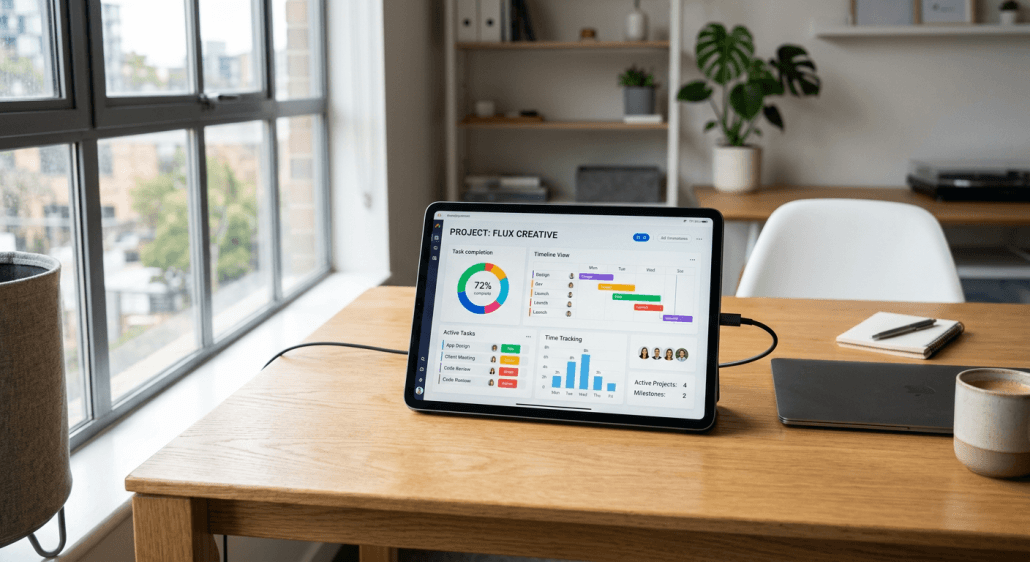
Top Project Management CRM Tools for Integrated Team Productivity and Billing in 2026
Selecting the right project management CRM requires balancing operational oversight with financial accountability. For modern businesses, the ideal platform acts as a central nervous system for client relations and internal execution, ensuring that every hour worked is accounted for and billable. Choosing between various work management tools depends heavily on whether your primary objective is deep CRM-driven sales tracking or automated, project-specific time and expense management.
Quick Summary
Project management CRM tools combine client relationship management with task execution, project tracking, and automated billing. These solutions enable teams to maintain profitability by linking client interactions directly to project deliverables and timesheets.
- Streamlines the transition from lead to project completion.
- Automates billing based on accurate project time tracking.
- Enhances visibility into team capacity and resource allocation.
- Provides a single source of truth for both client data and workflow status.
Table of Contents
- Comparison of Project Management CRM Categories
- Integrated CRM-Centric Platforms
- Project-First Management Suites
- Financial and Billing-Focused Tools
- Enterprise Resource Planning Solutions
- Buying Guide: Choosing Your Work Management Solution
- FAQ
- Recommended Reads
Comparison of Project Management CRM Categories
| Category | Primary Focus | Ideal For | Pros | Cons |
|---|---|---|---|---|
| CRM-Centric | Sales & Pipelines | Sales-heavy agencies | Strong lead management | Lacks advanced project scheduling |
| Project-First | Task Execution | Creative/Dev teams | Intuitive UI, task tracking | Weaker CRM reporting |
| Billing-Focused | Profitability | Professional services | Excellent invoice automation | Steep learning curve |
| ERP-Style | Enterprise Scale | Large organizations | Full organizational visibility | High cost, complex setup |
Integrated CRM-Centric Platforms
CRM-centric platforms bridge the gap between initial client outreach and the start of a project. These tools are designed for organizations where the sales lifecycle is complex and requires multiple touchpoints before a project is even greenlit. By embedding project management software features, these platforms allow account managers to turn won deals into active projects instantly.
- Pros: Seamless data flow from lead to project; automated notification workflows for sales-to-delivery handoffs.
- Cons: Often lack granular task management capabilities required for complex production or technical workflows.
Project-First Management Suites
For teams focused on high-volume delivery, project-first suites are the standard. These tools prioritize task dependencies, Gantt charts, and resource allocation. They integrate CRM modules to keep client contact information visible during the project lifecycle, ensuring that project managers know exactly which client needs are being addressed in each sprint or task, as seen in advanced project management platforms.
- Pros: Superior visual management of deadlines and milestones; better support for remote team collaboration.
- Cons: Billing and invoicing features are often secondary and may require integration with third-party accounting software.
Financial and Billing-Focused Tools
When your primary metric is profitability, billing-focused work management solutions are essential. These platforms emphasize time tracking, expense logging, and automated invoice generation. They are particularly valuable for agencies that bill hourly or on a retainer basis, as they provide “undisputable proof of work” through detailed time tracking software logs that sync directly with billing cycles.
- Pros: Minimized revenue leakage; real-time visibility into project profitability.
- Cons: Can feel restrictive to creative teams who dislike rigid tracking interfaces.
Enterprise Resource Planning Solutions
Often confused with tools like service now for project management, these large-scale ERP platforms offer a holistic approach to business operations. They provide comprehensive control over resources, personnel, and finances across the entire enterprise. While powerful, they are typically excessive for smaller teams but offer unparalleled reporting for complex, matrix-managed corporations.
- Pros: Scalability to enterprise levels; deep integration with all facets of organizational data.
- Cons: Expensive, requires specialized implementation teams, and often carries a high complexity overhead.
Buying Guide: Choosing Your Work Management Solution
Selecting from the available work management solutions requires an audit of your current bottlenecks. If your team struggles with project delays, prioritize tools with strong task scheduling. If your challenge is profitability, prioritize platforms with automated billing and automated time tracking.
- Audit Your Workflow: Identify if the friction is in the sales phase (CRM focus) or the execution phase (project management focus).
- Check Integration Depth: Ensure that any tool you choose links project time directly to invoicing, as this reduces manual effort and increases accuracy.
- Consider User Adoption: A tool with every feature imaginable is useless if your team finds it too cumbersome to record their time or update their tasks daily.
FAQ
- Q: Can I use a CRM as a standalone project management tool?
- A: While possible, most CRMs lack the task scheduling, dependency, and time-tracking features required for project management. A dedicated work management platform is usually more efficient.
- Q: How does time tracking impact billing?
- A: Integrated time tracking ensures every billable minute is captured, reducing disputes with clients and ensuring your agency protects its profit margins.
- Q: Is it better to use an all-in-one suite or multiple integrated tools?
- A: All-in-one suites typically offer better data consistency, whereas specialized tools often provide deeper functionality for specific niches.


