
Best Employee Time Clock App Options for Efficient Payroll in 2026
Modern businesses require precise data to manage labor costs and ensure regulatory compliance. Implementing a reliable employee time clock app is no longer a luxury but a necessity for organizations balancing remote, hybrid, and onsite workforces. By automating the transition from clock-in events to payroll processing, businesses can eliminate human error, prevent time theft, and gain actionable insights into operational efficiency.
Quick Summary
An employee time clock app is a digital solution that records workforce attendance, automates timesheet generation, and streamlines payroll workflows. These tools provide real-time visibility into labor costs, support legal compliance, and reduce administrative overhead through automated reporting.
- Improved payroll accuracy via automated data collection.
- Enhanced compliance with labor regulations and overtime laws.
- Increased visibility into project-based labor costs.
- Seamless integration with existing accounting and management infrastructure.
Table of Contents
- Quick Summary
- Comparison of Workforce Attendance Solutions
- Cloud-Based Enterprise Attendance Systems
- Mobile-First Workforce Tracking Platforms
- Hardware-Integrated Kiosk Solutions
- Project-Centric Time Tracking Suites
- How to Choose the Right Time Clock System
- FAQ
- Recommended Reads
Comparison of Workforce Attendance Solutions
| Feature Category | Primary Strength | Pros | Cons | Ideal Audience |
|---|---|---|---|---|
| Enterprise Cloud | Integration Depth | High scalability, payroll sync | High per-user cost | Large corporations |
| Mobile-First | Field Operations | GPS fencing, ease of use | Reliant on connectivity | Field technicians |
| Kiosk Hardware | On-site Control | Prevents buddy punching | Fixed location setup | Construction, Retail |
| Project-Centric | Profitability | Deep task insights | Steeper learning curve | Agencies, Consultancies |
Cloud-Based Enterprise Attendance Systems
These platforms focus on unifying human resources and payroll operations. By using a robust web based employee time clock, these systems ensure that data flows seamlessly from the point of entry into the company’s ledger. They are designed for high-compliance environments where audit trails and strict adherence to labor laws are critical to minimizing liability.
Advanced features often include AI-driven anomaly detection, which flags suspicious clock-in patterns or overtime violations before they reach the payroll stage. By utilizing sophisticated time tracking software, managers can delegate administrative tasks to the system while maintaining oversight of labor expenses across multiple departments.
Mobile-First Workforce Tracking Platforms
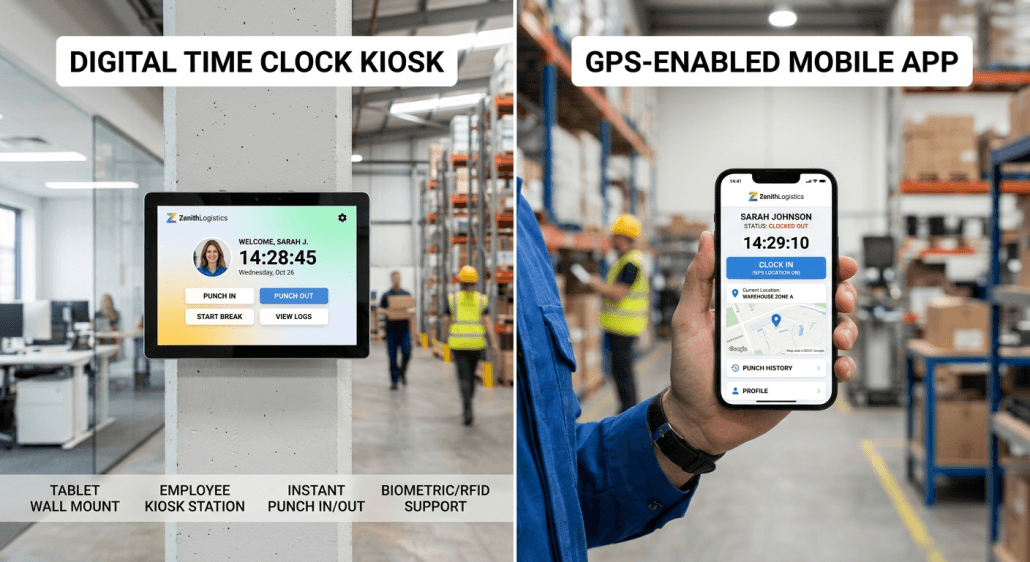
For businesses with a highly mobile workforce, such as logistics, field sales, or home services, mobile-first solutions provide the necessary flexibility to log hours from any location. These apps leverage GPS and geofencing to verify that employees are physically present at assigned job sites when they initiate their work sessions.
Using a dedicated employee clock in software built for mobile devices ensures that the experience remains intuitive for the end-user while providing managers with a centralized dashboard. This data can be enriched by automated time tracker capabilities, which minimize the need for manual input and ensure that every minute of billable time is captured accurately, regardless of the employee’s location.
Hardware-Integrated Kiosk Solutions
Industries that rely on centralized physical locations, such as manufacturing or hospitality, benefit significantly from dedicated kiosk interfaces. By converting a standard tablet or desktop into an employee time clock online, businesses create a stable, reliable point of entry that is less prone to the connectivity or battery issues of personal smartphones.
Kiosk systems often incorporate biometric authentication or photo verification to effectively eliminate “buddy punching” and ensure that the person clocking in is indeed the authorized employee. This high level of physical verification is essential for maintaining the integrity of shift records and providing indisputable proof of attendance to payroll departments.
Project-Centric Time Tracking Suites
Service-oriented businesses, such as marketing agencies or legal firms, require tools that track time not just against a shift, but against specific projects and tasks. These systems provide the necessary granularity to calculate project profitability, track billable versus non-billable hours, and generate client-ready invoices with minimal manual effort.
When integrated into a broader project management platform, these tools allow managers to compare estimated effort against actual performance in real-time. This visibility is vital for identifying bottlenecks, optimizing resource allocation, and ensuring that project margins remain protected throughout the lifecycle of complex deliverables.
How to Choose the Right Time Clock System
Selecting the appropriate solution begins with evaluating your organization’s primary environment. If your team is primarily remote, prioritize tools with strong screen-monitoring and activity-tracking capabilities to maintain accountability. Conversely, if your team is field-based, GPS verification and offline capability should be the driving factors in your decision.
Consider the integration ecosystem. The best software will sync directly with your existing payroll or accounting systems, removing the need for manual data entry. Finally, evaluate the scalability of the platform. A solution that serves a startup today must have the architecture to support a growing headcount without degrading performance or complicating the user interface.
FAQ
How does an employee time clock app prevent time theft?
Most modern applications use features like GPS geofencing, photo verification, and biometric identification to ensure that the employee is physically present at the authorized job site during their shift.
Can online employee timeclock systems handle complex overtime rules?
Yes, sophisticated platforms allow you to configure custom rules for daily, weekly, or holiday overtime, ensuring that payroll calculations automatically comply with local and federal labor regulations.
Are cloud-based systems secure for sensitive employee data?
Yes, reputable providers utilize industry-standard encryption, multi-factor authentication, and secure data backups to protect sensitive timekeeping information from unauthorized access.


