
200–400% ROI Possible: Time Tracking ROI Calculator for Managers
Time tracking typically pays for itself within weeks, and organizations that count billing leakage recovery alongside administrative savings often see substantial returns within the first year. The realistic path runs through a short calculation: gather your billable rates, current leakage estimate, and admin hours, then run them through the formula below. The sections that follow turn that verdict into a business case finance will actually approve.
TL;DR:
- Recovering billing leakage through automated, real-time capture can significantly boost ROI and deliver almost immediate financial gains.
- The average payback period for time tracking investments is typically within a few months, especially when both leakage and administrative savings are realized.
- ROI varies widely based on organization size, with small firms achieving 200-400%, mid-size consultancies often exceeding 800%, and larger agencies seeing even higher returns.
- Proper adoption relies on automated capture, consistent weekly reviews, and proactive management actions based on tracking data.
- The most valuable conditions for time tracking returns are organizations with inconsistent billing habits, scope creep issues, or unverified hours-worked gaps.
AYYES – Turn Time Data Into Clearer Returns
AYYES helps teams track time, projects, tasks, and work activity in one connected platform, making it easier to understand where working hours go and how that time affects billing, project delivery, and team productivity. It supports automated time tracking, idle detection, screenshots, app and website usage tracking, timesheets, reports, and invoice-related workflows that can help businesses reduce manual timekeeping and improve visibility into billable work. Pasted text The platform can be especially useful for teams trying to reduce billing leakage, improve project estimates, and cut the administrative time spent chasing or correcting timesheets. The article already identifies billing leakage recovery, fewer payroll corrections, reclaimed admin time, better project estimates, and improved utilization visibility as the main ROI drivers. Pasted text Pricing: AYYES is free for teams of up to 12 members. Paid plans start at $0.88 per seat/month with annual billing or $0.99 per seat/month with monthly billing. This low entry cost can make it easier for small teams to test time tracking before expanding to paid monitoring and reporting features. You can also update the line currently saying “free forever tier” to “free plan for up to 12 team members” for better accuracy
Table of Contents
- What Drives Time Tracking ROI?
- How Do You Calculate Time Tracking ROI?
- What ROI and Payback Range Should You Expect?
- How Do You Turn Tracking Data Into Financial Gains?
- When Should You Expect Payback?
- Who Backs This Guidance?
- When Is Time Tracking Worth the Investment?
- A Practical Next Step for Turning This Calculation Into Results
- Sources
- FAQ
What Drives Time Tracking ROI?
Time tracking ROI comes from five measurable levers, and each one converts directly into dollars once you know where to look. Billing leakage is the biggest lever for client-services firms. Unlogged or under-logged billable hours quietly erode revenue, and automated capture (rather than end-of-week memory reconstruction) recovers a meaningful share of that leakage almost immediately. Time theft and payroll errors, such as rounded clock-ins, buddy punching, or manual timesheet mistakes, create a second recovery pool; the Department of Labor’s wage-and-hour guidance underscores why accurate recordkeeping also reduces compliance exposure, not just payroll cost. Administrative time is the third driver: every hour a manager or bookkeeper spends chasing timesheets or reconciling invoices is an hour that automated reporting gives back. Fourth, better historical data sharpens project estimation, which cuts the overruns that quietly eat margin on fixed-bid work. Fifth, utilization visibility lets you plan capacity instead of guessing at it.
- Billing leakage recovery from automated, real-time capture
- Reduced time theft and fewer payroll correction cycles
- Manager and admin hours reclaimed from manual timesheet chasing
- Sharper project estimates that reduce scope and cost overruns
- Better utilization data for staffing and capacity decisions
Pro Tip: Run a two-week manual audit before you buy anything. Compare logged hours to invoiced hours; the gap is your baseline leakage number, and it is the single most persuasive figure in any ROI pitch to finance.
How Do You Calculate Time Tracking ROI?
The formula is simple, but the inputs decide whether the output is credible or wishful thinking. ROI% = (Annual Savings − Annual Cost) / Annual Cost × 100 Payback period = Total Implementation Cost / Monthly Net Savings To run it, you need six inputs:
- Number of employees tracked and their fully loaded hourly cost
- Average billable rate (for client-services teams)
- Current estimated leakage percentage (from a manual audit or payroll review)
- Weekly admin hours spent on manual time tracking or invoice reconciliation
- Software subscription cost per user, annualized
- One-time implementation and training cost
Here’s a worked example for a 20-person consultancy billing at $120 per hour, with an estimated 8% leakage and 10 admin hours reclaimed weekly at a $35 loaded hourly cost. The Harvard Business Review’s caution on productivity claims is worth heeding here: always present the conservative column first, and treat the realistic column as an upside case, not the headline number.
What ROI and Payback Range Should You Expect?
Benchmarks vary by business model, but the pattern is consistent: leakage recovery moves fastest, estimation gains move slower. Structured tracking combined with a regular feedback loop has been shown to help teams recover 2 to 4 hours of productive time per week once managers actually act on the data. Vendor business-case frameworks, including AppIt Software’s worked model, consistently show strong ROI once both billing leakage and admin savings are counted together, with payback typically landing within a few months. Three quick scenarios illustrate the spread:
- Small firm (5 people): Lower absolute dollar savings, but low software cost keeps ROI in the 200 to 400% range with payback under two months.
- Mid-size consultancy (20 to 50 people): Leakage recovery dominates; ROI commonly lands in a high percentage range depending on billing rate.
- Agency (50+ people, multiple clients): Admin savings and estimation improvements compound; realistic ROI often exceeds 800%, but takes longer to fully materialize.
Billing rate and current leakage percentage move the ROI needle harder than any other variable. When presenting to finance, show a range rather than a single number, and apply a modest downward adjustment to your optimism before anyone else has to.
How Do You Turn Tracking Data Into Financial Gains?
Software alone doesn’t produce ROI. Adoption and a working feedback loop do. Start with capture that requires almost no manual input. Default timers, automatic idle detection, and app or website usage tracking beat manual entry because compliance is the biggest single point of failure in any rollout. Keep required fields minimal (project, task, client) and add granularity only where it changes a decision.
- Launch with automated capture as the default, manual entry as the exception
- Set a weekly review cadence comparing estimated versus actual hours by project
- Give managers a dashboard view instead of raw timesheet exports
- Act on what the data shows: reassign underused capacity, automate recurring admin tasks, or adjust pricing on chronically underbilled work types
- Revisit categories quarterly and cut any that nobody actually uses in a decision
Pro Tip: If a report doesn’t change a staffing, pricing, or billing decision within a month of being generated, the category behind it is probably overhead, not insight. Cut it. Estimation accuracy improves fastest when the same manager reviews the same team’s estimates week over week, since feedback loops measurably tighten forecasting over time. 
When Should You Expect Payback?
Billing leakage recovery and admin time savings show up first, often inside 30 days, because they require no behavior change beyond consistent logging. Estimation accuracy and utilization gains take longer, usually 6 to 12 weeks, since they depend on accumulating enough historical data to spot patterns.
- 30 days: Leakage recovery visible; admin hours starting to drop
- 90 days: Estimation accuracy improving; utilization data usable for staffing calls
- 180 days: Pricing and scope adjustments based on tracked data fully in effect
The most common pitfall isn’t the software. It’s skipping the weekly review, which lets logged data pile up unused, or over-engineering the category structure before anyone has proven the simple version works.
Who Backs This Guidance?
This piece is written and maintained by Mark, an editorial contributor focused on operational finance and workforce technology, drawing on published business-case frameworks and wage-and-hour compliance guidance rather than single-vendor marketing claims. The product design maps directly to the ROI drivers above:
- Automated time capture with idle detection, so leakage recovery doesn’t depend on employee memory
- Screenshot reporting and app or website usage tracking that give managers visibility without micromanaging
- Built-in invoice generation that connects logged hours directly to billing, closing the leakage gap faster
- Scalable plans, including a free forever tier, so a small team can validate the calculation before committing to a larger rollout
When Is Time Tracking Worth the Investment?
The highest-ROI situations are client-billed work with inconsistent logging habits, teams running fixed-bid projects with a history of scope creep, and any organization that has never audited the gap between hours worked and hours invoiced. In those cases, the math above tends to understate the real payoff. Tracking is a lower priority for small teams on flat retainers with stable, well-understood scope, where there’s little leakage to recover and limited estimation risk to manage. The rule of thumb: invest when uncertainty about where time goes is costing you money you can’t currently measure; wait when you already know the answer.
— Mark
A Practical Next Step for Turning This Calculation Into Results
The calculation above is only as good as the data feeding it, and that’s where most manual rollouts stall. This software closes that gap by automating the inputs the formula actually needs: billable hours, idle time, admin hours spent on timesheets, and project-level accuracy, all captured without asking employees to self-report anything. 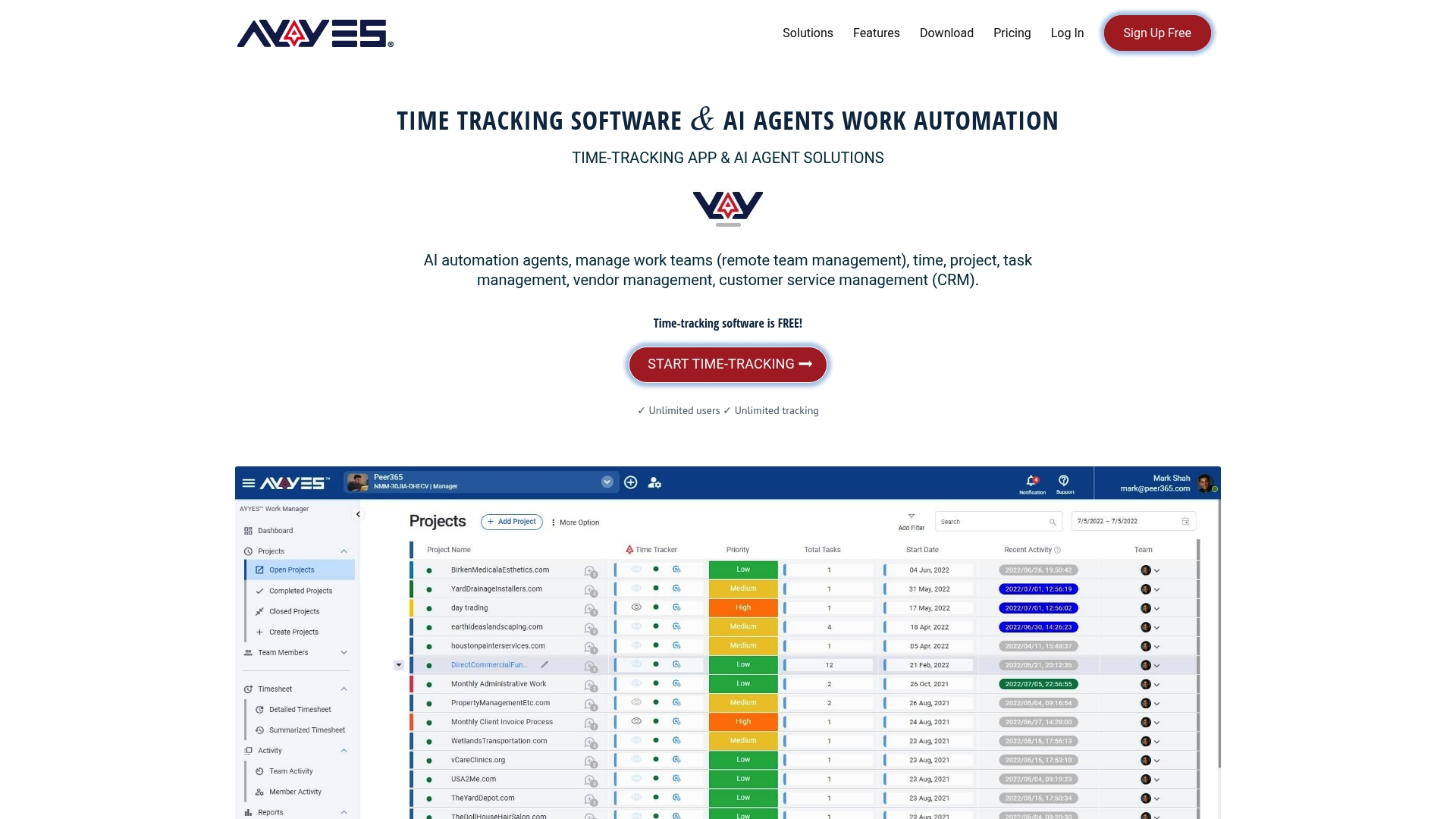 If billing leakage recovery and admin time savings are the two levers most likely to move your ROI, consider how automated capture, screenshot reporting, and invoice generation can handle both without adding a manual step to anyone’s week. Run your own numbers through the calculator framework above using a two-week trial on the free forever plan, then decide whether the realistic or conservative column better reflects your team.
Sources
The ROI formula and worked benchmarks above draw on AppIt Software’s business-case framework, estimation-accuracy research from BeyondTime.ai, compliance guidance from the Department of Labor, the measurement caution in Harvard Business Review, and the Time ROI concept explained by UseACalculator.
- AppIt Software — Time Tracking ROI: How to Build the Business Case
- Beyondtime
- U.S. Department of Labor — Wage and Hour Division fact sheets
FAQ
How Do You Calculate ROI With Time?
Use ROI% = (Annual savings − Annual cost) / Annual cost × 100, where savings combine recovered billing leakage, reduced time theft, and admin hours reclaimed, and cost includes software, implementation, and training.
What Does “Track ROI” Mean in This Context?
It means measuring the financial return generated by monitoring where hours go, then converting that visibility into recovered revenue and reduced administrative cost rather than tracking hours for its own sake.
What Does “ROI on Time” Mean?
“ROI on time” often refers to Return on Time Invested (ROTI), a framework for valuing how time spent on an activity compares to the benefit gained, distinct from the financial ROI calculated at the organization level.
What Does a 20% ROI Mean for Time Tracking?
A 20% ROI means the net savings equal 20% of what you spent on the software and implementation, which is well below the multi-hundred percent range typical of properly implemented time tracking and usually signals underused reporting or weak adoption.
How Long Does It Take to See Payback?
Billing leakage recovery and admin savings often show up within 30 days, while estimation accuracy and utilization gains typically take 6 to 12 weeks to fully materialize.